 GroupFloGet the app
For iPhone and iPad
Built by a practicing rehab therapistGroup Therapy Made Simple.
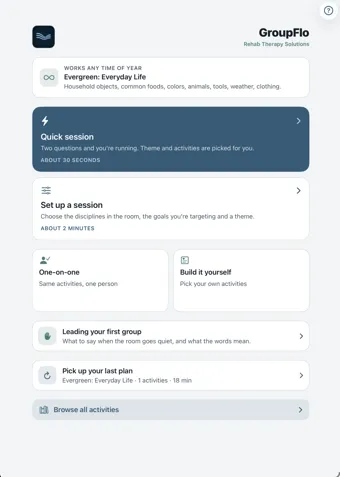
GroupFlo plans and runs group therapy sessions in skilled nursing, inpatient rehab, and long-term care. Tell it who is in the room and how long you have, and you get a complete, timed session — then it leads you through it, activity by activity and prompt by prompt, while the group is happening. The same activities and prompts run one-on-one, so they fit into everyday treatment too.
Only $49.99/year
14-day free trial. Cancel any time in your Apple Account.
GroupFlo: Rehab Therapy Solutions
47
activities across PT, OT, and speech
34
clinical goal areas to target
71
themes, seasonal and evergreen
1,500+
prompts, questions, and rounds to draw from
The problem
Group therapy is clinically valuable, and almost nobody is trained to lead it.
The planning happens in the gaps: on a lunch break, or in the five minutes before the group starts. The same three activities get recycled until the room is bored, timing is a guess, and everything has to be improvised when a patient gets pulled out mid-activity.
And the hardest moment is not the planning. It is the silence twenty minutes in, when an activity lands flat and you have no idea what to do next.
Most resources give you material to prepare from. GroupFlo is made to be held during the session and read from live.
It is for physical, occupational, and speech therapists and assistants who run group treatment — and especially for the clinician who did not choose this. The new graduate. The traveler on their first week at a site. The PRN therapist handed a group with twenty minutes’ notice. Anyone whose training covered one-on-one treatment and never covered standing in front of eight people.
If you have led groups for years, it saves you from reinventing a session every week. If you are new to it, you are never without the next thing to say.
How it works
Two ways to start, and one shape every session keeps.
A session in about thirty seconds
Three questions — which disciplines are in the room, how many people, how long you have. GroupFlo picks the theme and tells you which one it chose and why. If you want more control, full setup takes about two minutes and lets you choose the goals and the theme yourself.
It always asks who is in the room
Even when you are in a hurry. Your answer is what shapes the session, so a room of speech patients never gets handed a standing balance drill just because you were short on time.
Every session has a shape
A warm-up, the main work, a wind-down. That shape holds even when you pick the activities yourself, so a group never ends cold on a cardiovascular circuit.
What’s inside
A library deep enough that the room never hears the same group twice.
47 activities, each with a script
Ball toss and balloon volley, sit-to-stand and stepping work, folding and sorting and table-setting simulation, word retrieval, rhyming, reminiscence interviews, role-play of everyday errands, structured cool-downs. Each one comes with a materials list, setup instructions, safe timing ranges, and the group sizes it works for.
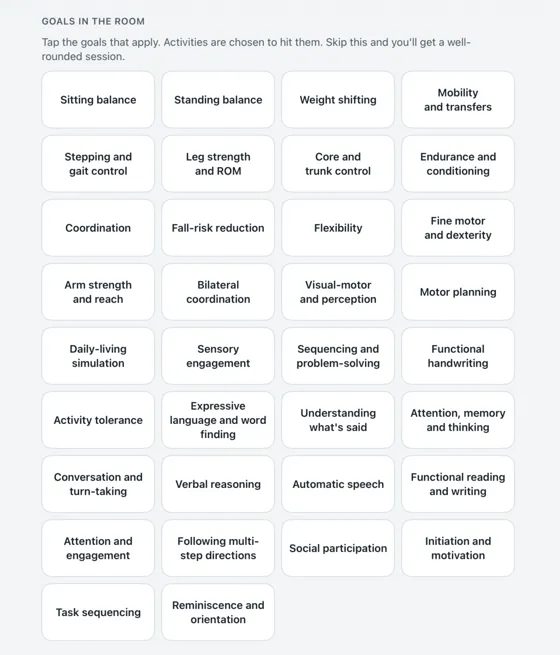
34 clinical goal areas
Across the three disciplines, plus shared targets like attention, multi-step directions, initiation, and social participation. Pick the goals you are treating and you get activities that work on them.
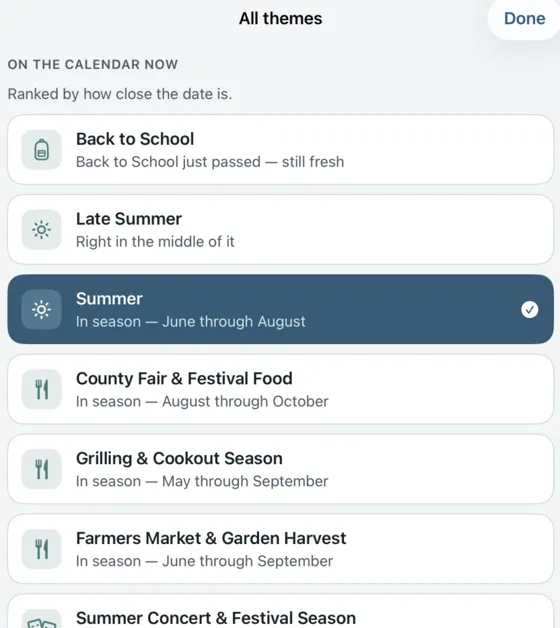
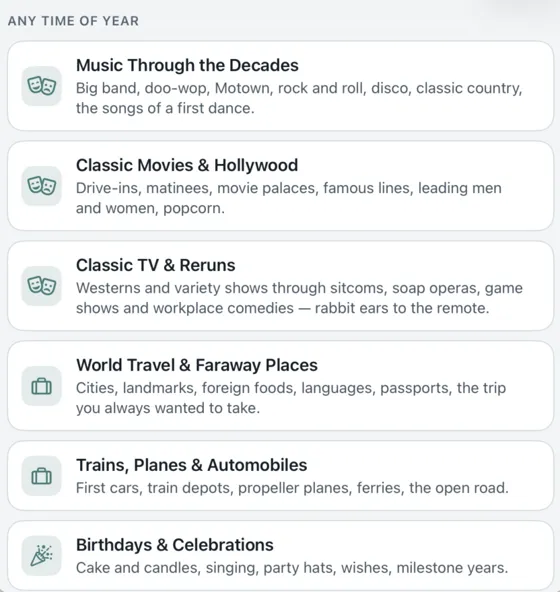
71 themes
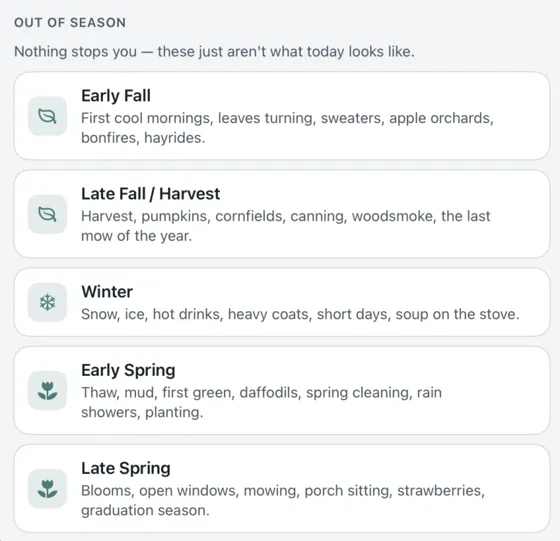
Seasons, sports and championships, awards season, holidays, travel, food and cooking, home projects, hometown geography, work and trades, animals, nostalgia by decade. A theme makes a session feel like this week instead of generic.
Over 1,500 sets of prompts
The actual questions, prompts, and sorting rounds that fill each activity, chosen to fit both the activity and the theme. You never have to think one up on the spot.
Saved sessions deal fresh prompts
Run the same saved session again a month later and the prompts are new, so nobody hears a repeat. You can also build a session by hand from your favorites or the full library.
One-on-one
Not every session needs a group.
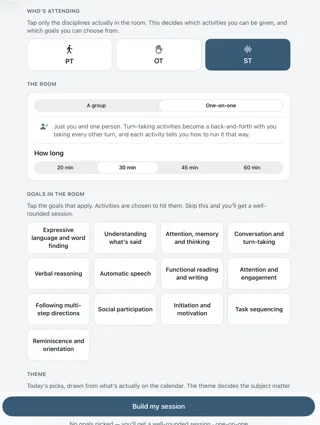
The same activities and prompts run with a single patient, so the library is something you draw on in day-to-day treatment and not only on group day. Set the session up for one, and the prompts adjust to the person in front of you.
No group required
Choose one-on-one at setup and the entire library opens up for a single patient. Nothing is held back behind a minimum headcount, and the session is built and timed the same way.
Prompts adjust to the participant
The prompts, questions, and rounds reshape for one person. Turn-taking becomes back-and-forth with you, and what you are handed is pitched to that patient’s goals and level rather than to a room.
Fits the treatment plan
Pull an activity into a scheduled visit to work the goals already on the plan of care, then export the same session summary for your charting.
Everything that follows works the same either way: the timer, the precautions, the one-tap swap, and the words already written for you.
During the session
One activity at a time, in large type, with the words already written.
While the group is running you see one screen: a timer, the activity you are on, and the exact words you can read out loud. It is sized to be read at arm’s length, or turned around and shown to the room.
Precautions
Confirm them before an activity starts.
Materials
What this activity needs, listed where you can see it.
What to say
Wording you can read out loud to keep the activity going.
One-tap swap
Change activities when the materials turn out to be missing.
Three buttons handle what actually goes wrong.
For when the room is engaged and the clock disagrees.
Patients get pulled out for a shower or a ride. Tap once and the rest of the session is re-timed for the people still there, with your options spelled out in plain language — plus something to say to the group about the person who just left.
Opens straight onto the situations that actually come up — the room went quiet, one person dominated, an activity flopped — and gives you words to say. The timer keeps running underneath.
At the end you get a session summary you can export — for your charting, or to pass along to the colleagues who were in the room.
Pricing
Two ways to buy it
One price for a therapist, one for a department. Both are on this page, because you should not have to book a call to find out what something costs.
One therapist
$49.99per year
14-day free trial
Bought on the App Store. It belongs to your Apple Account, so it works on every iPhone and iPad you sign in to, and it comes with you if you change jobs.
A team of six or more
$39.99per therapist, per year
30-day pilot
Invoiced to the facility. The seats belong to the department rather than to individual staff, so when someone leaves, the seat stays and goes to whoever replaces them.
Team pricing starts at six therapists and saves ten dollars a seat. Five or fewer, buy individually on the App Store — the paperwork would cost you more than the discount saves, and we would rather say so than sell you a contract.
More than 25 therapists, or several buildings? Write to us and we will work it out with you.
What the team plan includes
The app is identical in both plans. What changes is who owns the licence and how you pay for it.
Seats that survive turnover
App Store subscriptions attach to a person’s own Apple Account, so a licence leaves with the therapist. Team seats are held by the facility and reassigned to whoever fills the role next.
Bought the way your finance office expects
A written agreement, a purchase order, an invoice, net-30 terms and a W-9. No corporate card, no expense report, no one paying out of pocket and waiting to be reimbursed.
Installed by your IT, not by each therapist
Distributed privately through Apple Business Manager, so it appears on department iPads without anyone signing in to a personal Apple Account or entering a password.
A 30-day pilot for the whole team at once
Everyone starts on the same day, after a short onboarding session, so your therapists can compare notes and you can make one decision at the end instead of twelve.
A compliance packet before you buy
Written confirmation that no business associate agreement is required, a plain summary of how the app handles data, and a named person to ask. GroupFlo collects nothing, and we will put that in writing for your reviewer.
Write to sales@groupflorehab.com with the number of therapists and the setting, and we will send terms the same week.
Privacy
No patient data. No facility data. Ever.
What that looks like in practice.
Works fully offline
No connection needed, anywhere in the building. Its App Store privacy label is Data Not Collected.
Nothing to type about a patient
A headcount is the only thing about the room that ever goes in.
No accounts, no tracking
Nothing to sign up for, and nothing recorded about how you use it.

Speech-language pathologist in acute care and inpatient rehab, and the founder of GroupFlo.
About the founder
Built by a rehab therapist, for rehab therapists.
GroupFlo comes from Bri Worek, a speech-language pathologist who is still on the floor: she currently treats patients in acute care and inpatient rehabilitation in a hospital. She earned her master’s in speech-language pathology from West Virginia University in 2011 and began practicing in Pittsburgh, working with medically complex tracheostomy and ventilator patients in a skilled nursing facility and specializing in voice and dysphagia management.
In 2016 she became a traveling therapist along the East Coast before settling in North Carolina. Her clinical background also includes extensive work in cognitive-linguistic rehabilitation for dementia, stroke recovery, and other neurological conditions.
Acute care, inpatient rehab, skilled nursing, traveling assignments, neuro caseloads: those are the conditions GroupFlo is designed around, and they are conditions Bri still works in. A group already on the schedule, a room you have not met yet, and no quiet hour in which to plan for it. Alongside her hospital work she keeps a private practice in Nashville, Tennessee, coaching singers, performers, and professionals on voice and communication.
- Currently practicing in acute care and inpatient rehabilitation in a hospital
- M.S. in speech-language pathology, West Virginia University, 2011
- Skilled nursing: medically complex tracheostomy and ventilator patients, voice and dysphagia management
- Cognitive-linguistic rehabilitation for dementia, stroke recovery, and other neurological conditions
Coming soon
Walk into the next group with the session already built.
GroupFlo: Rehab Therapy Solutions is coming to the App Store for iPhone and iPad. Built by a rehab therapist for rehab therapists, with no accounts to make, nothing to set up, and it works fully offline.